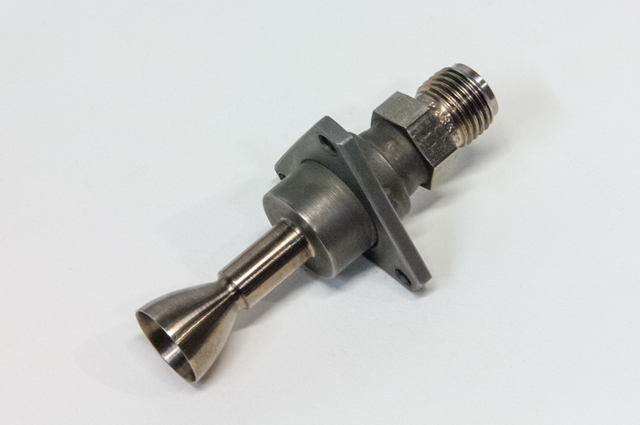
Resistojet Thruster (2007)

Michael Fuchs Resistojet Thruster

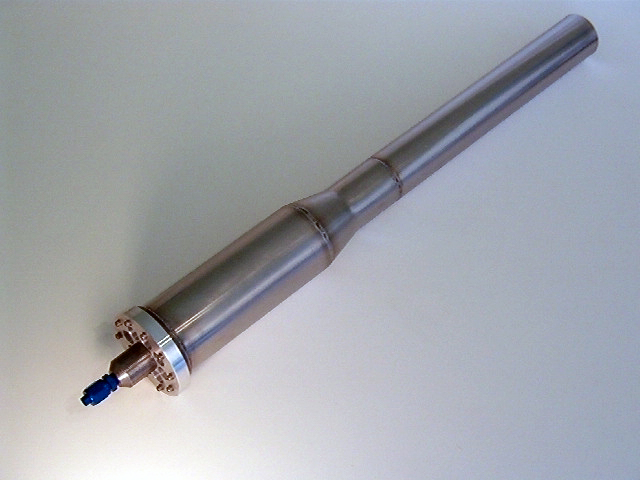
This was a very simple micro phase-change resistojet thruster that I designed and fabricated to primarily evaluate my thruster vacuum test setup with different area ratio thruster nozzles.  The thruster heated the propellent using a low voltage glow plug and was fueled with small quantities of water. I tested the thruster for several hours under different propellent flowrates and chamber vacuum levels.

Pulsejet Engine (2006)

Michael Fuchs Pulsejet Engine

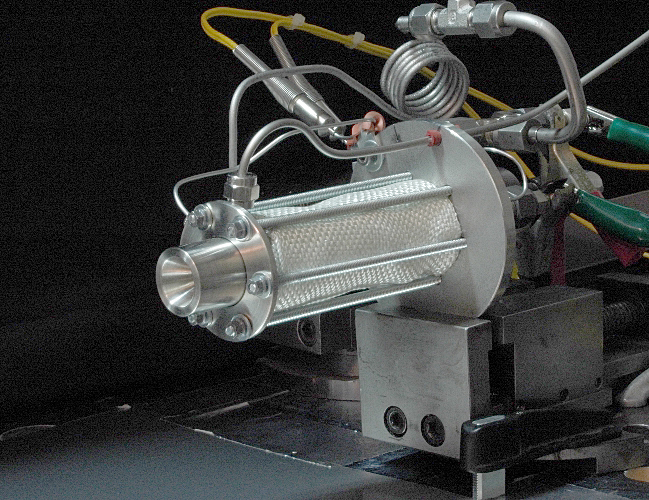
This was a very short duration design/build/test project that I did to show one of my co-op students at the time that you can complete a full engineering design through test project in a few days with minimal coast if you adequately simplify the requirements. This engine was a unique design but copied many details of heritage engines.  The engine operated well on gaseous propane for a total of about 30 minutes of run time.  The pulse frequency was higher than optimal making the engine hard to cold start, but a longer exhaust duct likely would have improved that problem.

Nitrous Oxide Mono-Fuel Thruster (2005)

Michael Fuchs Nitrous Oxide Mono-Fuel Thruster

This was a very short duration design/build/test to test the thermal value of decomposing nitrous oxide in a catalyst as a potential mono-fuel thruster propellent.  I heated incoming nitrous oxide using a resistance heater and then passed the heated gas through an insulated platinum ceramic catalyst.  Thermal conditions were measured on each side of the chamber to quantify the energy that was released during the nitrous oxide decomposition.  The heating contribution of the instrumented resistance element was double checked by running back-to-back non-decomposition test runs using carbon dioxide in place of the nitrous oxide.  Thrust was not measured, and the nozzle assembly was primarily incorporated to provide chamber backpressure.

Jet Engine Ignition System (2002)

Michael Fuchs Jet Engine Ignition System

This was a high frequency jet engine ignition assembly that I designed and built to support some of the jet engine testing that I was doing at the time.  The intent of the design was to make a relatively safe ignition device that would produce a very high voltage, low current, ignition arc with a long duty cycle. I used a 555 timer to feed high frequency chopped DC to a high voltage transformer. The project was a good integrated circuit design learning experience.  The ignition unit worked well, and I used it on several subsequent engine test projects, but it tended to produce significant EMF that interfered with data acquisition and nearby low voltage signal measurements. 

Gaseous-Fuel Rocket (1998-1999)

Michael Fuchs Gaseous-Fuel Rocket

I did this design/build/test project to work in the area of rockets and thruster engines for the first time.  To minimize safety risk, and to simplify the propellent system, I designed this engine to operate on moderately low-pressure gaseous oxygen and propane.  The walls of the combustion chamber were cooled by integrated compressed air channels.  I intentionally oversized the combustion chamber to allow for the testing of different injector plates, flame stabilizers, and combustion position sensors.  Overall, it was a good learning experience, and I completed several hours of run time.  The engine was well instrumented with thermocouples, pressure transducers, and infrared flame position sensors that were cooled with dry ice.  The engine was started with a glo plug trigger dry chemical pyrotechnic ignitor. As part of this project, I also built a small test bunker that all of the engine tests were conducted in.

Augmented Centrifugal Turbojet (1996-1998)

Michael Fuchs Augmented Centrifugal Turbojet

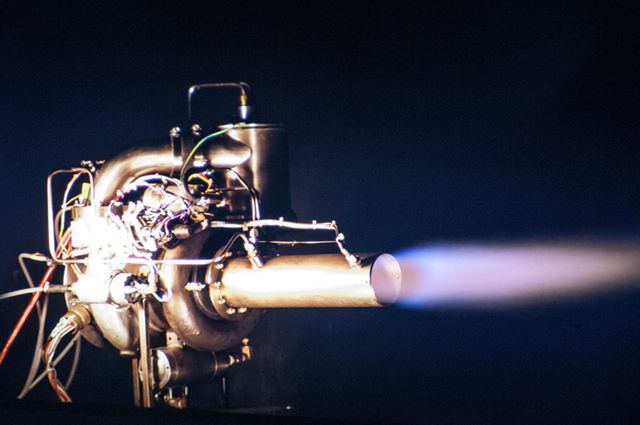
This was very successful turbojet that I built with the lessons that I learned from my previous smaller scratch-built engine design projects.   I tested this engine for several total hours in multiple runs including some runs with full afterburner. I learned a lot from previously machining all of my own turbomachinery, but for this larger engine, I decided that I wanted to concentrate on engine cycle thermodynamics and engine subsystem design, so I made this engine by significantly modifying a diesel heavy equipment turbocharger. Interestingly, it was an original idea of mine to make turbocharger based jet engines at the time of this project; years later, I discovered that others were working with similar designs in Canada and the east coast around that same timeframe.

Ultralight Jet-Tipped Helicopter (1997)

Michael Fuchs Ultralight Jet-Tipped Helicopter

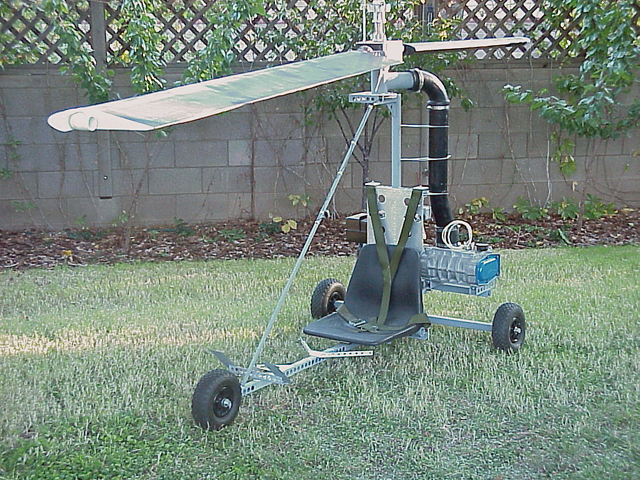
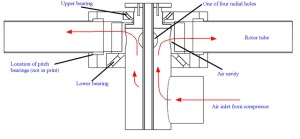
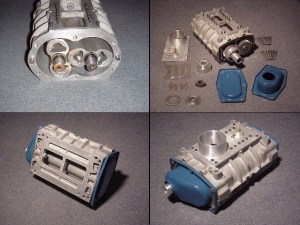
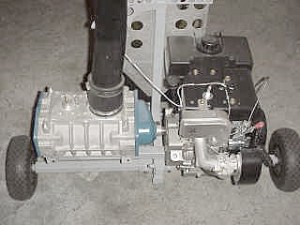
This was a small compressed air jet-tip helicopter rotor assembly and testbed that I designed and built to explore the feasibility of helicopters without tail rotors.  This was the first-full sized aircraft assemly that I designed, and it was a great learning experience for mass properties management, structural analysis, and safety factors.  I made the rotor blades out of fiberglass that I molded around CNC hotwired cut foam cores that were bonded to a chromoly structural tube that also functioned as the compressed air duct. A lot of the project centered around the design and fabrication of the rotor head that incorporated compressed air passages surrounding the rotor blade pitch control mechanisms.  I supplied compressed air to the rotor system using a roots blower that was driven by a 4-stroke engine.  I performed dozens of tethered tests running the rotor up to different speeds and variable blade pitch configurations.

Aft-Fan Turbofan (1996)

Michael Fuchs Aft-Fan Turbofan Engine

The design intent of this engine was to develop a simple turbofan upgrade that could be added to a basic turbojet core that I previously developed. I built this engine on the gas-generator core of my previous kerosene centrifugal turbojet.  I CNC machined the aft fan out of a single alloy steel plate with a pressed in (and radially pinned) stainless steel inner turbine.  The furthest aft fan bearing assembly was total-loss water cooled with a small amount of pressurized water. Overall, the engine ran well and worked as a two-spool turbofan.  At the end of testing, fan turbine thermal distortion caused the fan turbine and fan hub to separate causing fan imbalance.

Ethanol Centrifugal Turbojet (1996)

Michael Fuchs Ethanol Centrifugal Turbojet

During the build of the previous kerosene centrifugal turbojet, I built 2 or 3 of each part.  This engine was assembled from the second set of parts. The design intent of this engine was to improve on the kerosene centrifugal turbojet and evaluate the performance of a small ethanol can-annular chamber while experimenting with several different prototype turbine inlet nozzles.   Overall engine performance was similar to the previous kerosene engine.  This engine was my first can-annular engine.